In Warsaw, Poznań, or other cities in Poland, the historical center of the city is known as the “Old Town” or “Starówka.” It is a place where you can find the most monuments of the city, and life pulsates both during the day and at night. Interestingly, Gdańsk does not have a typical “Old Town” as we commonly know it by name. The proper term that describes the place where you will find the most characteristic monuments and attractions associated with Gdańsk is the “Main Town.” Therefore, our exploration will start from here
From Hotel Milo to the city center, you can get in several ways:
- If you are a fan of public transportation and exploring the city while traveling, we recommend the direct bus 210. Although it takes about 45 minutes, you can use this time to admire the city through the windows or plan further points of your excursion.
- Another, probably the most convenient and certainly the fastest means of transportation is a car. In the afternoon, you can reach the city center in as little as 25 minutes, and traffic jams usually occur in the opposite direction at that time. The only potential downside here is finding parking, which can be challenging during the Dominican Fair or on weekends.
- An interesting and visually appealing option is choosing the Pomorska Kolej Metropolitalna (PKM), which offers pleasant landscapes in the slightly less crowded and greener part of Gdańsk.
We have arrived!
To feel like a true local, you should start your walk from the so-called “Lot.” This old building, with its somewhat intimidating architecture, is known to all locals as a landmark for meetings, and it serves as a starting point to go to a pub or restaurant. Behind us, we see the Forum shopping gallery, which opened a few years ago and presents itself impressively, and on the right side, the first historical object of the Main Town of Gdańsk – the Wyżynna Gate. Right after it, don’t miss the Przedbramie Complex with the Gdańsk Museum, the Torture Museum (a small museum of torture), and a small Viewing Tower. It’s worth stopping there for a moment to get a preliminary overview of the distinctive buildings and monuments of Gdańsk described on the 4 pages of the world. A taste before continuing the walk.
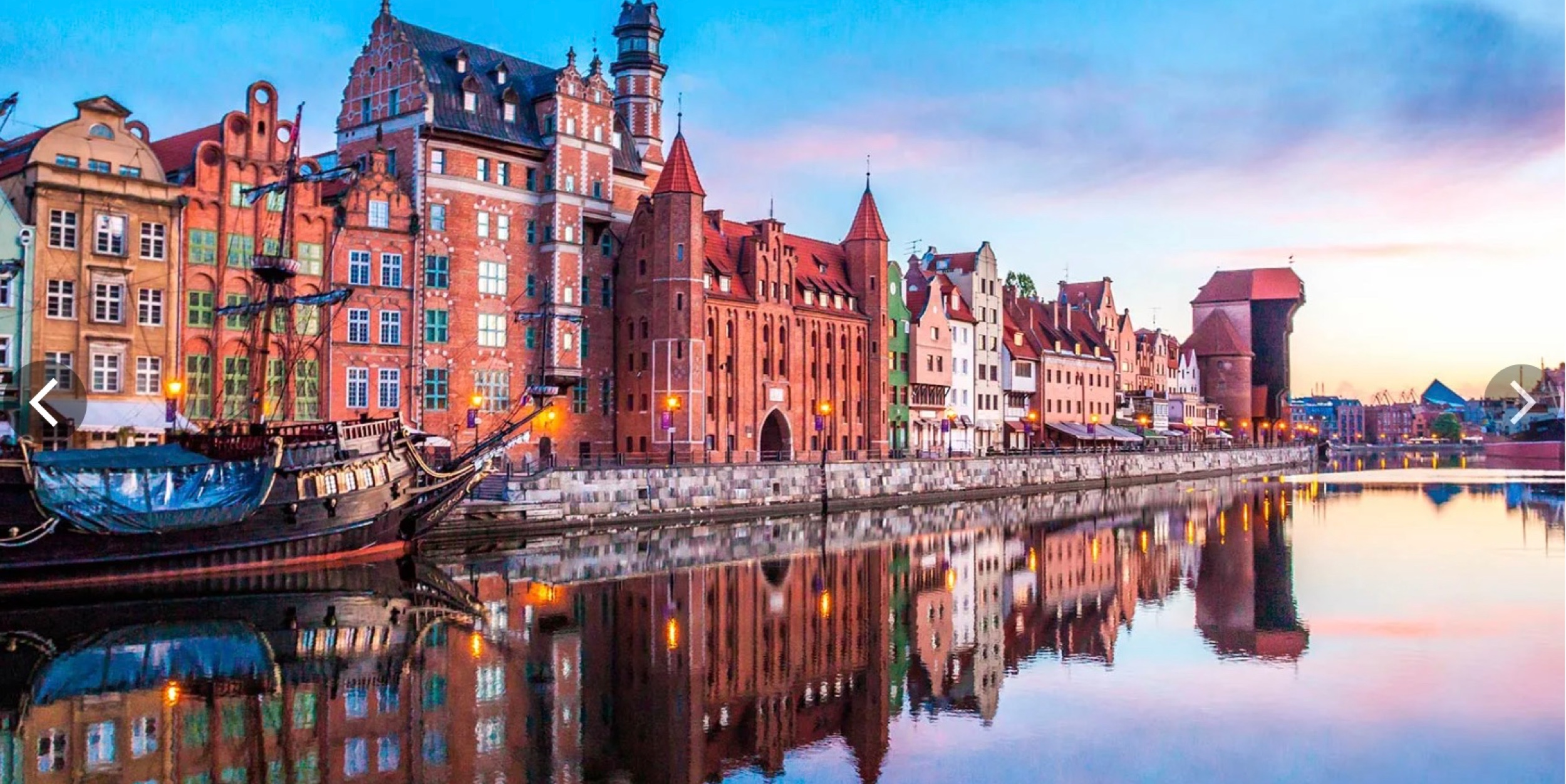
The next point of the excursion is to enter the Long Street through the Golden Gate. From there, on the left side, you can admire the Main Town Hall, dominating the panorama of the Royal Route, the most representative route in this part of the city. Continuing on from Long Street to Long Market on the left side, we pass by the Neptune Fountain and the Artus Court (a branch of the Gdańsk Museum). Don’t forget to look around in every direction to admire the beautiful, colorful houses, the city’s business card and symbol. Although as a result of wartime actions, the vast majority of Long Market’s buildings were destroyed, the reconstruction aimed to partially preserve the original architecture and sculptural decoration.
At the very end of Long Market, there is probably the oldest water gate in Gdańsk – the Green Gate. Behind it is a bridge over the Motława River and Granaries Island, which has recently become the new entertainment center of the city with restaurants, pubs, hotels, and apartments. It’s no wonder that life has moved there. The view of the Motława River is phenomenal, and the density of gastronomic points in one place allows everyone to find something for themselves. Maybe it’s time to have a meal?
After lunch, it’s worth going back to the other side of Granaries Island. That’s where you’ll find another city landmark – the Gdańsk Crane. A walk along the Long Waterfront will lead you to the so-called Gdańsk Eye, an observation wheel that provides a view of the magnificent city panorama. This is also the direction to choose when going to the Museum of World War II or back, venturing into the heart of the Main Town to reach St. Mary’s Basilica, one of the largest brick churches in the world, from whose tower you can also admire the views. To get to the top, you only need to climb 409 steps
In addition to the above-mentioned attractions, here are many other places you must see while in the Main Town:
- Mariacka Street – commonly known as the Amber Street
- Piwna Street – an intimate, atmospheric, and charming street with many cafes, pubs, and restaurants
- Shakespeare Theatre
- Wybrzeże Theatre
- Baltic Philharmonic on Ołowianka, in the immediate vicinity of the Main Town
Among the main attractions and monuments of the Old Town and its surroundings are:
- Great Mill
- Main Railway Station
- Madison Shopping Gallery
- Old Town Hall • Gradowa Hill on the outskirts of the Old Town
- St. Catherine’s Church with the surrounding houses
- St. Joseph’s Church
- St. Bridget’s Church
- Small Mill
- Solidarity Museum